Sustainable Governance
Corporate Governance Framework and Committee
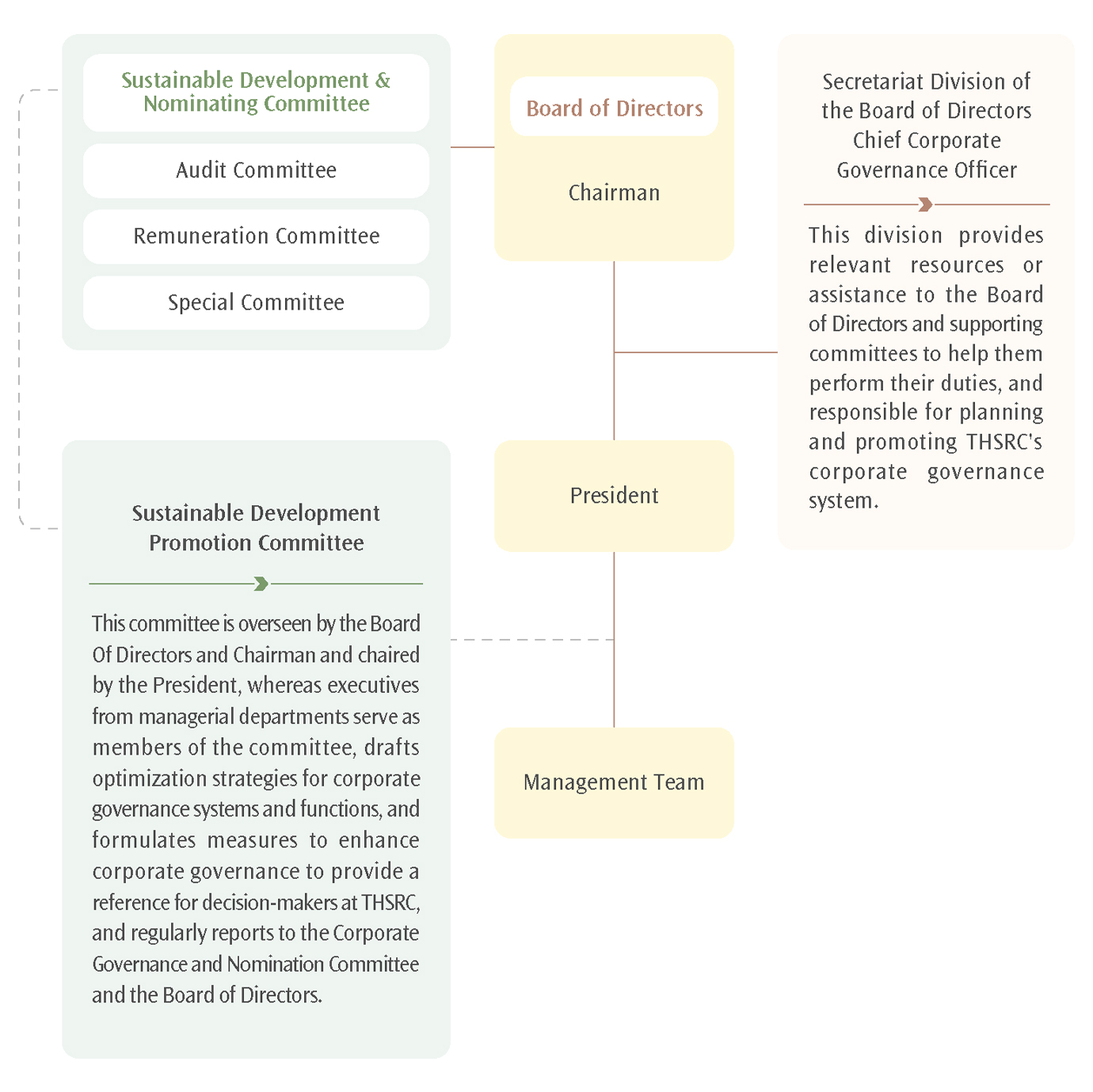
THSRC firmly believes that sound, transparent, and efficient corporate governance is the key to sustained and robust development. The Company has established the "Corporate Governance Guidelines" in accordance with domestic regulations and set up the Board of Directors and various functional committees under its jurisdiction to optimize the overall governance effectiveness of the Company through management mechanisms. THSRC has established the "Sustainable Development & Nominating Committee" under the Board of Directors, with an Independent Director serving as the chairperson. Its composition includes three Independent Directors and two directors. The committee supervises the "Sustainable Development Promotion Committee", which is composed of the top management personnel and responsible for formulating THSRC's sustainability strategies and plans, as well as reviewing the effectiveness of implementation.
The Sustainable Development Promotion Committee is chaired by the President, with members including Senior Vice Presidents and the conveners of each working team (department/office-level managers). The Committee convenes a meeting every quarter, reports the implementation status to the Chairman every six months, and reports to the Sustainable Development & Nominating Committee and the Board of Directors each year. There are six working teams under its jurisdiction including the Environmental Sustainability Team, Sustainable Service Planning Team, Employee Care Team, Social Integration Team, Corporate Governance Team, and Ethical Management Team. These teams research and develop strategic directions for corporate sustainable development, formulate specific implementation plans, and track the effectiveness of implementation. In 2025, the primary discussion topics of the Sustainable Development Promotion Committee covered the implementation status of corporate governance, sustainable development, ethical management, and legal compliance. This included the review of the annual plans and implementation status of the six teams, as well as the effectiveness of relevant projects (such as information security, legal compliance, human rights, and T-Shopping reduction targets). For the responsibilities of the Sustainable Development Promotion Committee and its working teams, please refer to the diagram below. For the 2025 operational status, please refer to the "Sustainable Development Status" section on the official website.
THSRC continues to strengthen its culture of sustainable governance. Since 2018, the Company has been ranked among the top 5% of listed companies in the Corporate Governance Evaluation for nine consecutive years, and in 2024 received the CG6014 (2023) Corporate Governance System Evaluation Certificate with an Excellent ranking (conducted biennially) from the Taiwan Corporate Governance Association. THSRC will continue to execute the corporate governance framework, actively implement engagement with stakeholders, and practice rigorous corporate governance strategies. For further information related to corporate governance, please refer to the corporate website Corporate Governance, 2025 Annual Report, and the Market Observation Post System (MOPS).
Corporate Governance Framework Chart
Responsibilities of the Board of Directors and Information on Board Members
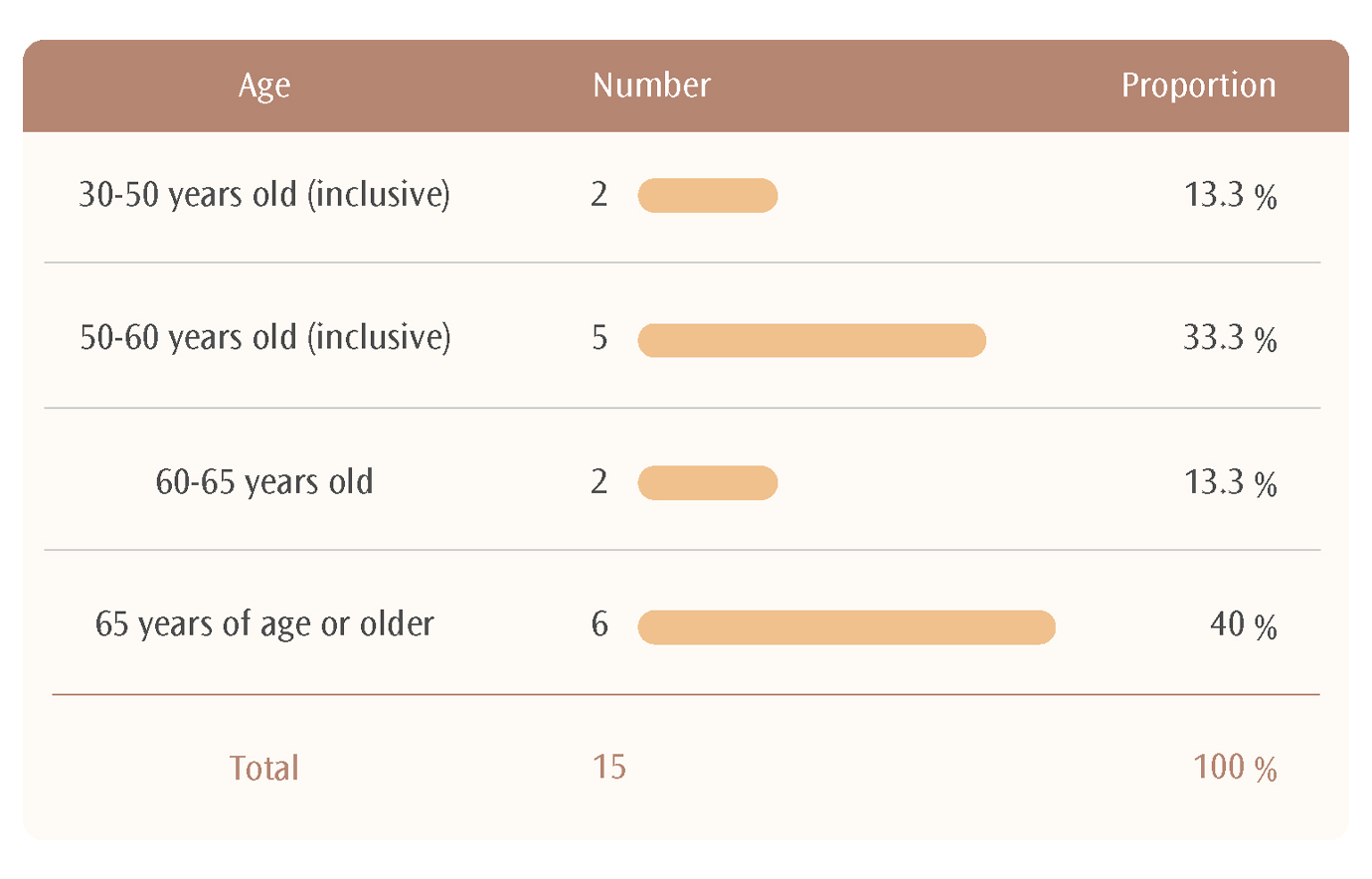
The Board of Directors serves as THSRC's highest governing body. Its main strength and responsibilities include the power conferred by relevant laws and regulations, and the shareholders' meeting, reviewing significant regulations, business plans, budgets, financial statements, and important business, as well as supervising management execution results and guiding the management team. As of May 2026, the Board of Directors has 15 directors (including 5 independent directors), with 93% (14) men and 7% (1) woman, and we will strive to increase the proportion of female directors in the future to meet the norms of diversity in governance organizations. At present, the average age of the Board of Directors is 61.7 years old, including 6 doctors, 4 masters and 5 bachelors, all of whom have relevant professional backgrounds and relevant ESG experience required by the transportation industry. In terms of professional ability, the Board of Directors as a whole has the ability of marketing technology, business management, law, financial accounting, leadership decision-making, industrial knowledge, crisis management and international market view. Please refer to Appendix Table 2 for composition background on the members of the Board. The age distribution of the Board is as follows:
Functional Committees
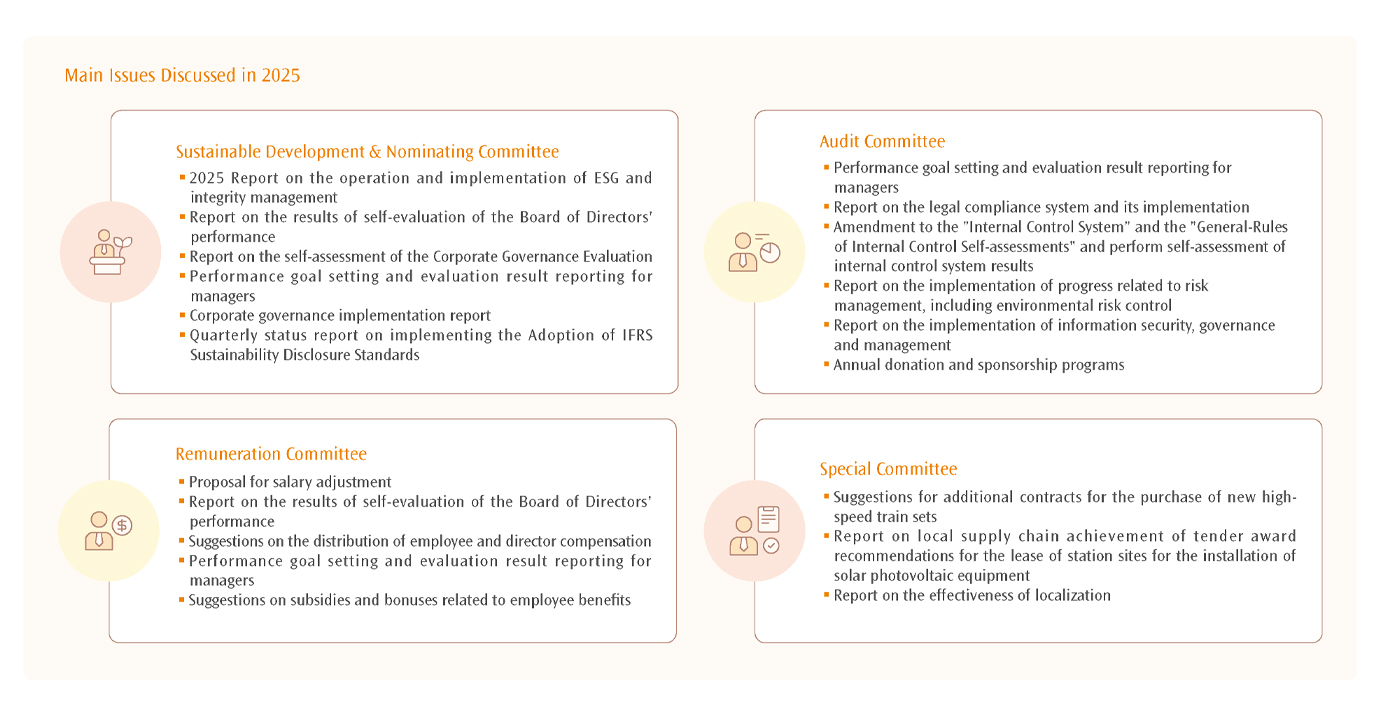
THSRC has established functional committees under the Board of Directors, including the Sustainable Development & Nominating Committee, Audit Committee, Remuneration Committee, and Special Committee. These committees assist the Board of Directors in performing its supervisory and advisory duties, discussing relevant topics, and submitting conclusions and recommendations to the Board for resolution. The primary sustainability topics discussed by each functional committee in 2025 are listed below. For detailed mandates, functions, and operational status of each functional committee, please refer to the "Functional Committees Main Duties and Members" and "Operation Status of Functional Committees" sections on the corporate website.
2025 Financial Results
Starting from July 2025, THSRC increased its weekly scheduled services to 1,128 trains. Driven by high demand from business, tourism, and homecoming passengers, ridership continued to grow, with the total number of passengers exceeding 80 million for the first time, which increased railway transportation revenue to NT$52.7 billion. Furthermore, on the foundation of sustainable operations, THSRC continued to optimize its financial structure and corporate governance performance.
Performance Highlights
- In 2025, THSRC recorded total annual revenue of NT$54.65 billion (comprising NT$52.7 billion in railway transportation revenue and NT$1.95 billion in other income), with a net profit after tax of NT$6.58 billion. Driven by record- breaking ridership, our revenue in 2025 grew by 2.8% compared to 2024.
- In 2025, THSRC continued to implement financial measures to reduce capital costs in response to interest rate hikes, resulting in total annual interest expenses of NT$6.46 billion.
- THSRC issued the first Sustainability Bond in Taiwan's transportation industry in August 2021 and the funds were used for green and social benefit investments. In September 2025, the Company issued additional Social Responsibility Bonds and used the funds raised to pay for the "station platform door installation" project. This investment is classified as affordable basic infrastructure and included the installation of platform door equipment at 11 stations across the line. This project aims to maintain the safety of passengers and the high- speed rail operation system, enhance public safety and operational quality, and support the Company's sustainable management philosophy and policies, effectively promoting and implementing THSRC's vision for sustainability.
- From the time the Central Bank raised the benchmark interest rate (rediscount rate) in March 2024 through the end of 2025, THSRC focused on reducing corporate debt and interest expenses. In October 2024, the Company reduced the issuance of unsecured commercial paper signed and issued in 2021 by NT$10 billion. In May 2024, we reduced the issuance of unsecured commercial paper signed and issued in 2022 by NT$1.575 billion, followed by a further reduction of NT$1.575 billion in May 2025. This cumulative reduction of NT$13.15 billion in the issuance of unsecured commercial paper successfully lowered interest expenditures.
- THSRC negotiated with the loan syndicate to modify the terms of the syndicated loan agreement and lower the markup rate. The reduced rate conditions became applicable in January 2024 and continued through 2025, resulting in significant interest savings.
Industry Exchange
THSRC proactively connects with the international community through technical visits, international delegations, and local industry-academia cooperation to constantly improve rail industry technology. THSRC joined the International Union of Railways (UIC) in 2009 and the International High-Speed Rail Association (IHRA) in 2014 as a member. Since then, the Company has enthusiastically supported events and initiatives organized by international unions and associations. In October 2025, THSRC Chairman Che Shih led a delegation to Tokyo, Japan to attend the 2025 IHRA Forum. The delegation shared experiences and engaged in exchanges with different countries to promote international industrial cooperation, thereby enhancing THSRC's international visibility and influence.
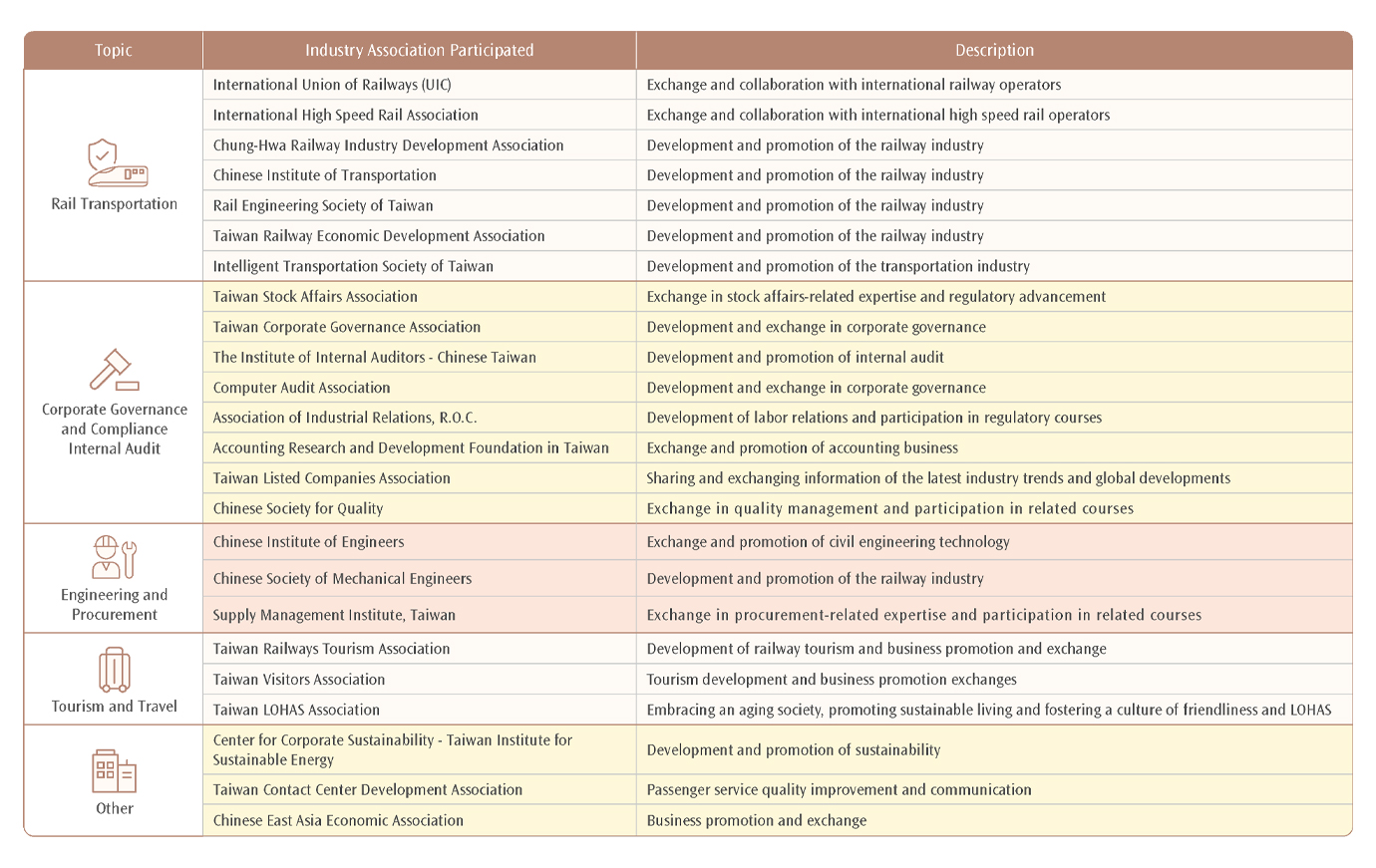
In addition, the 9th Mass-Trans Innovation Japan 2025 was held in Tokyo, Japan, in November 2025. THSRC Chairman Che Shih personally led a delegation to visit Japan and held talks with manufacturers tasked with the production of the new generation rolling stock (N700ST) and related supporting engineering for the introduction of the new trains. They exchanged opinions regarding subsequent arrangements to ensure a smooth introduction process for the N700ST while continuing to enhance the exchange of ideas and cooperation with railway operators in other countries. The Railway Technical Center (RTC) of the National Kaohsiung University of Science and Technology has a long-term academic-research partnership with THSRC. It participated in the exhibition for the first time and showcased abundant research and development achievements, including multiple successful results in collaboration with THSRC. It demonstrated the technical capabilities of Taiwan's railway industry to railway operators across the world. THSRC also vigorously supports the development of the domestic railway transportation industry. In 2025, the Company participated in 24 industry associations as a member (please refer to Table 1 in the Appendix) and maintained close partnerships with domestic and foreign transportation and railway operators to jointly promote the development of Taiwan's railway industry. Through technical collaboration and experience sharing, the Company continues to enhance the professional knowledge and capabilities of personnel in the Operation Control Center, station service/train service, and vehicles, delivering higher-quality and more innovative transportation services to passengers.
THSRC Industry Associations Participation in 2025
Local Industry-Academia Cooperation
THSRC signs Memorandums of Understanding (MOU) on Industry-Academia Cooperation with domestic colleges and universities. The Company uses partnerships in projects and seminars to enhance our technical expertise, strengthen the technical capabilities of the local railway industry, and accelerate the localization of equipment and components. Highlights of industry-academia collaboration in 2025 included the development of an overhead contact line inspection data management and trend analysis system, which integrates inspection data management and maintenance mechanisms, automatically compares inspection results across different months to identify locations requiring attention for wear or determine abnormal wear conditions, and features a work order instruction function. The Company also implemented local production of the BS-RTU system equipment for substations and signaling communication rooms by redesigning the hardware and software architecture and completed CE certification and EN 62368-1 low-voltage safety regulation certification in April 2025. The localization of PA broadcasting microphones and communication handsets for 700T trains has reduced procurement costs, ensured broadcasting system reliability, and enhanced autonomous maintenance capabilities. The program also resolved raw material issues caused by discontinuation of production at the original manufacturers and maintained good and stable communication quality.