Customer Relationship Connections

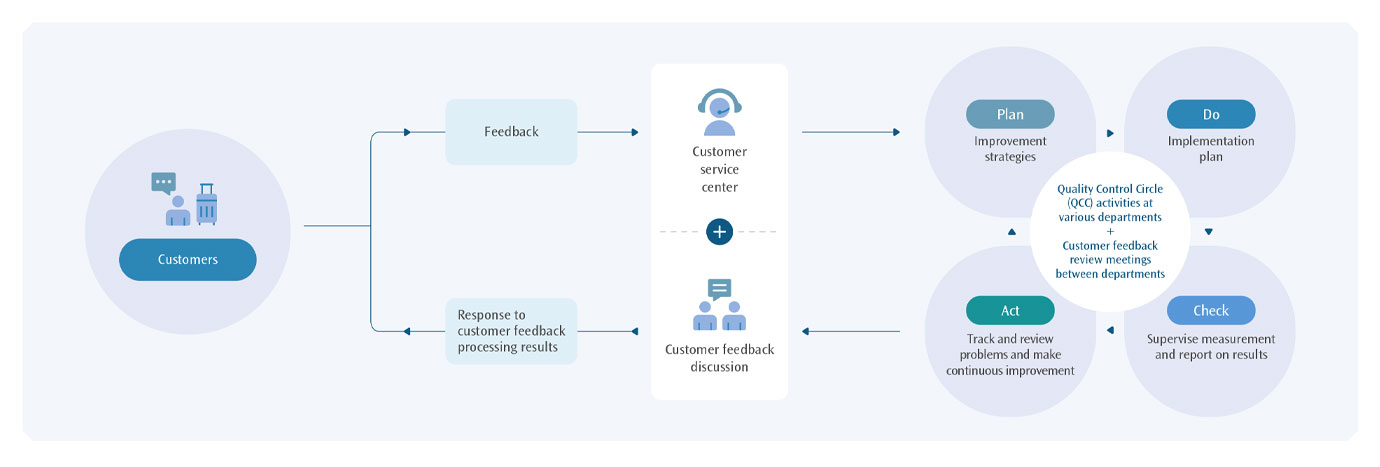
THSRC continues to provide thoughtful services, gaining real-time insights and responding to passenger needs through front-line contact points (including the Customer Service Center, stations, and trains) and diverse communication channels (direct channels such as Digital Customer Service and the Contact Us email on the corporate website). These efforts aim to enhance customer relationship management. The Customer Service Center is staffed with personnel proficient in Mandarin, Taiwanese, and English to serve passengers who speak different languages. Furthermore, to ensure that customer feedback is integrated into management and effectively improved, THSRC has established a dedicated department and complaint resolution mechanisms. In addition to providing immediate consolation and handling, customer feedback is reported to the quality management units of various departments and discussed in cross-departmental customer feedback review meetings. Utilizing the PDCA (Plan-Do-Check-Act) framework, the Company formulates strategies, executes plans, analyzes results, and conducts continuous follow-up and improvements.
Current Feedback Collection Channels and Customer Service Operations System
THSRC implements systematic management of customer feedback, and the system automatically notifies and reminds responsible units to conduct investigations. The dedicated department then consolidates the findings and responds within seven working days. In 2025, the achievement rate was 100%. In 2025, the Customer Service Center handled approximately 731,000 cases through phone calls and Digital Customer Service consultations. The primary inquiry items included ticketing, lost property, and promotional activities. Among these, approximately 316,000 cases (43%) utilized the self-service functions of Digital Customer Service, and they were primarily initiated for inquiries regarding timetables, ticketing, and travel guides, as well as online self-service applications for lost property.
THSRC's Digital Customer Service system not only provides 24/7 year-round consultation for Frequently Asked Questions (FAQ) but also includes personalized self-service functions such as wheelchair seat reservations and travel guidance applications. The wheelchair seat reservation service optimization project won the "Best Service Innovation Enterprise" award at the 2025 CSEA Excellent Customer Service Award. In 2025, the Company added a new "carriage issue reporting" function for passengers to use the system to report sources of noises in carriages or request cleaning assistance for spilled drinks. Since its launch, the system has handled an average daily volume of cases more than 10 times that of in-person customer service reports, significantly increasing self-service capacity and processing efficiency.
Current Customer Complaint Resolution Mechanism
Information Security Management
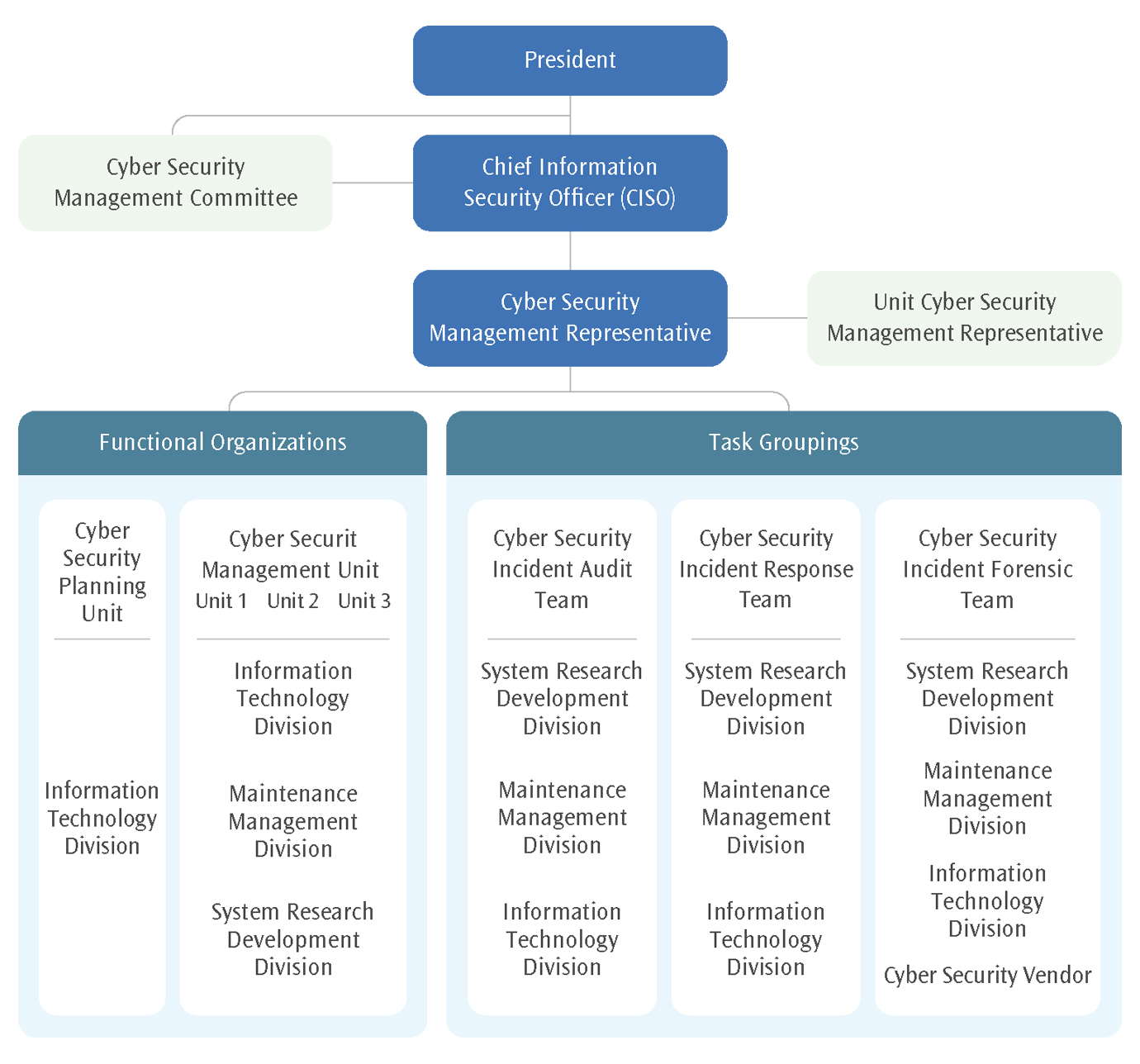
With the development of technology, online infringements and digital crimes have become increasingly frequent. THSRC established the "Cyber Security Management Committee" in 2017 and appointed information security officers from interdepartmental units to hold cyber security management review meetings every six months and convene cyber security officer meetings every quarter, reviewing the development direction, strategies, and implementation results of information security to ensure the steady operation of the information security management system. In 2025, a total of two cyber security management review meetings and four cyber security officer meetings were held. The information security governance report and results have been submitted to the 27th meeting of the 10th Board of Directors in 2025. For more information regarding information security policies and management plans, please refer to theTHSRC corporate website.
THSRC Information Security Management Framework
Implementation of Personal Information Security Maintenance Measures
| Safety Maintenance Measures for Personal Information Protection Management |
Personal Information Management Measures and Implementation Results in 2025 |
|---|---|
| Establish a Management Organization and Allocate Considerable Resources | Segment representatives formed "the Personal Information Protection Implementation Group," and a personal information representative meeting is held every quarter, with a total of four meetings conducted in 2025. |
| Risk Assessment and Management Mechanism for Personal Information | A three-level management model is adopted based on the security level of personal information files, and risk identification and assessment of personal information files are conducted, along with regular inventory audits to maintain the accuracy of the "Personal Information File Inventory." |
| Information Security Management and Accident Prevention, Notification, and Response Mechanisms | Information is classified into three types: written forms, electronic files, and system files, and relevant regulations on personal information security incident response, a complete notification mechanism, and review and improvement measures have been established. As of 2025, no personal information leakage incidents have occurred. |
| Awareness Promotion, Education and Training | Education and training are provided for new employees, with one hour per session, as well as one hour of annual training for all employees. |
| Equipment Safety Management | Terminal equipment (including personal computers, notebook computers, and mobile devices) and various types of servers are handled in accordance with THSRC's relevant information security management regulations. |
| Overall Continuous Improvement of Personal Information Security Maintenance | The annual audit results are regularly reviewed at the information security and personal information representative meetings and reported to the Cyber Security Management Committee. |
THSRC continues to strengthen information security operations in 2025, such as the use of Virtual Private Network (VPN) and employee remote work emergency measures and information security protections, as listed in the table below, to enhance the information and communication security environment.
Information Security Considerations in Procurement
- Cooperate with national information and communications security operation, conduct internal inventory and replace products that endanger national information and communications security, and restrict the use and provision of products that endanger national information and communications security when selecting external business partners.
Security
- Employees log into the Company's intranet from the external network and use two-factor
- If an abnormality occurs, the VPN device will complete the switch within 1 second, and the password and One Time Password (OTP) must be re-verified.
Monitoring Mechanism
- VPN uses two-factor authentication and monitors the source IP of the connection.
- Integrate information security monitoring mechanisms and conduct 24/7 monitoring and reporting through the information center computer room.
- Track high-privileged accounts.
- Implement endpoint protection mechanisms for user endpoint devices.
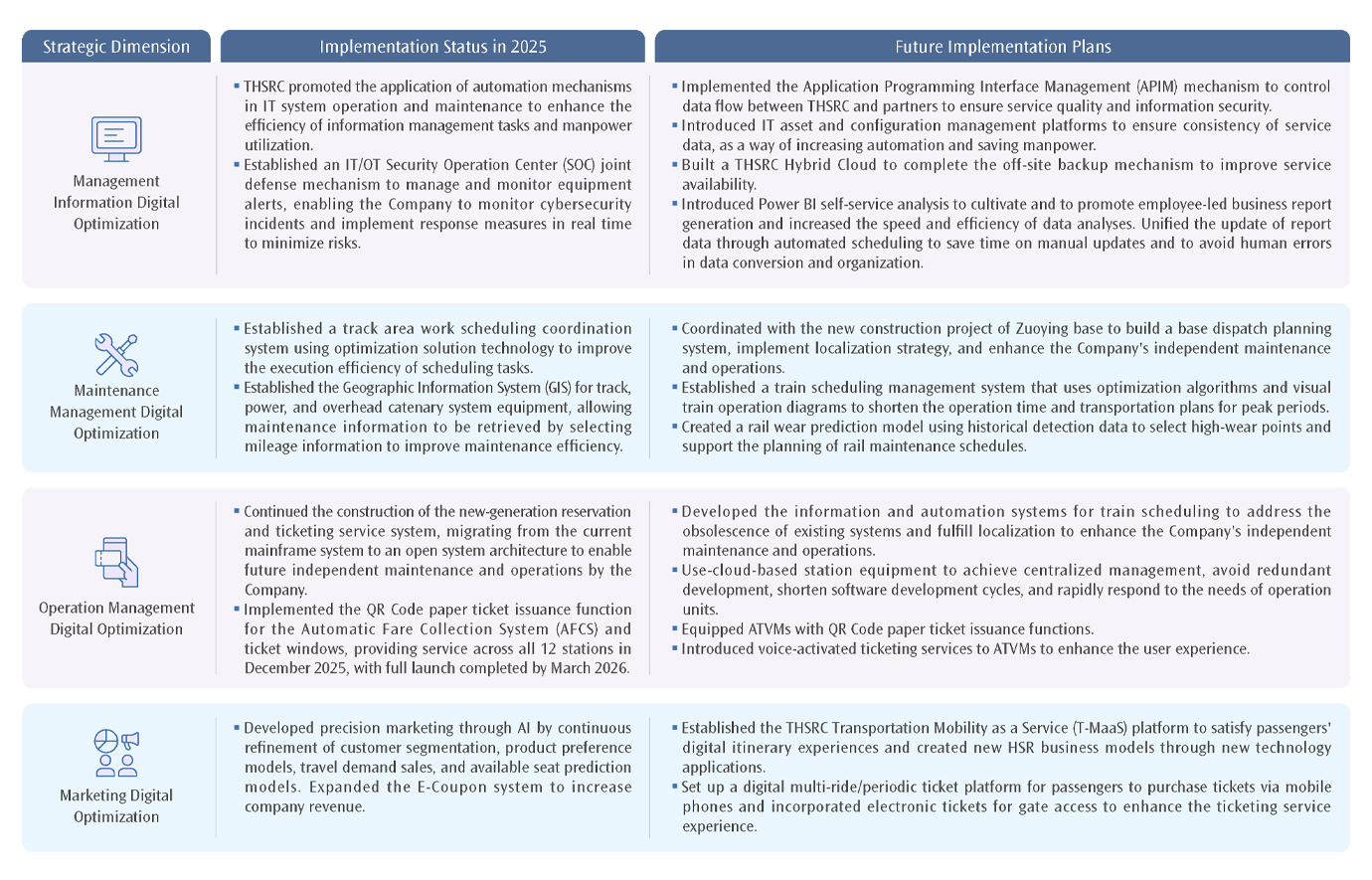
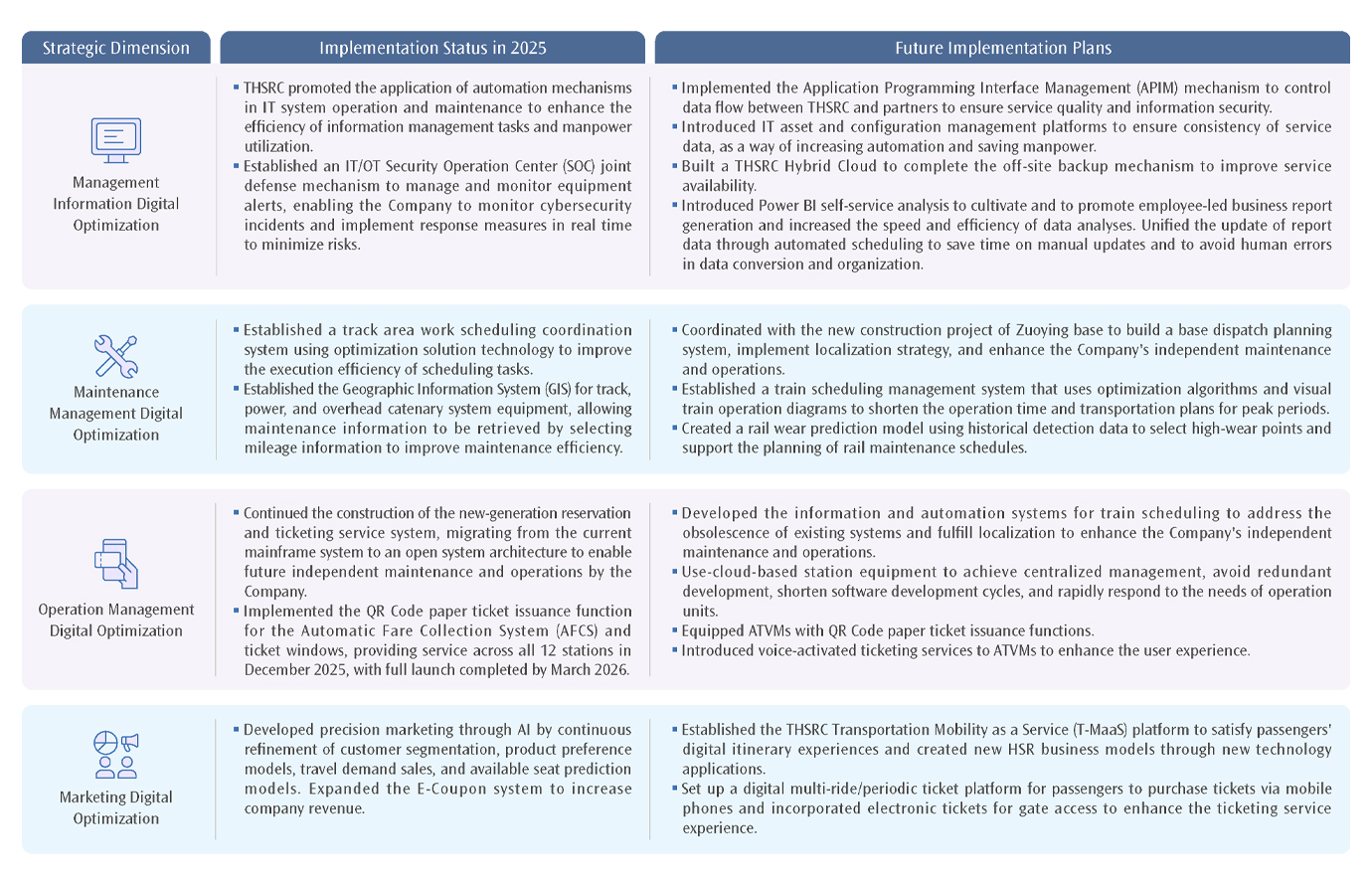
In response to the goal of "Accelerating Digital Optimization and Moving Towards Digital Transformation," one of the six mid- and long-term strategic directions of THSRC, the Company continues to accelerate digital transformation and has formulated four development strategies for high-speed rail information technology, including management information digital optimization, maintenance management digital optimization, operation management digital optimization, and marketing digital optimization. The projects and goals planned for implementation are as follows: