Energy Management Plan & Internal Carbon Pricing
Energy Management Plan
Policies
Environmental protection is an important part of THSRC's social responsibility. We treat the environmental issues such as environmental management, energy saving, water saving, waste reduction, green building, ecological conservation, environmental education, green procurement and local environmental care seriously. With the integration of international trends on environmental protection, THSRC pursue a sustainable business operation.
- Define our core business as 4T of Transportation, Technology, Taiwan and Touch, as we strive to provide green and intelligent service and seek to be the platform for advancement and enjoyment.
- Ensure that all corporate activities comply with environmental regulations and fulfill the commitments of environmental impact assessment.
- Strengthen the environmental protection concept for employees, contractors and passengers.
- Promote the effectiveness of green and low-carbon transportation services.
- Commit to improving environmental performance, developing and regularly reviewing environmental objectives to ensure that daily operations are carried out with appropriate processes and resources to prevent or mitigate environmental impacts.
Energy-Saving Targets
THSRC emphasizes energy conservation and carbon reduction, and continues to promote four major energy-saving schemes (autonomous energy conservation management, reduce electricity consumption, transfer peak electricity usage, and use electricity reasonably) at the Company's 5 maintenance depots and 12 stations. We also formulated plans to improve energy efficiency and build low-carbon stations, and established an annual electricity-saving target threshold of 0.86% per passenger trip for all sites (stations and maintenance depots). In 2024, our average electricity consumption per passenger trip (1.20 kWh) was reduced by 4% compared to 2023 (1.25 kWh). As of the third quarter of 2025, our average electricity consumption per passenger trip was 1.182 kWh, a reduction of 1.50% compared to 2024.
Energy-Saving Actions
Stations: Implement green building designs
THSRC station designs are based on sustainable “ecology, energy conservation, waste reduction, and health” concepts, and our stations implement various energy-saving measures based on local geographical conditions and environments to reduce impacts from building materials and air-conditioning. Miaoli Station, Changhua Station, and Yunlin Station were planned and designed using green building indicators, and were built by local vendors to reduce carbon footprints during construction periods. The stations also implemented greenery, energy conservation, solar power generation, and water retention measures based on the nine major green building indicators. The aforementioned three stations have all received green building certificates issued by the Ministry of the Interior (Miaoli Station received a Diamond Level certificate, Changhua Station received a Gold Level certificate, and Yunlin Station received a Gold Level certificate) as well as Green Building Certification Plaques.
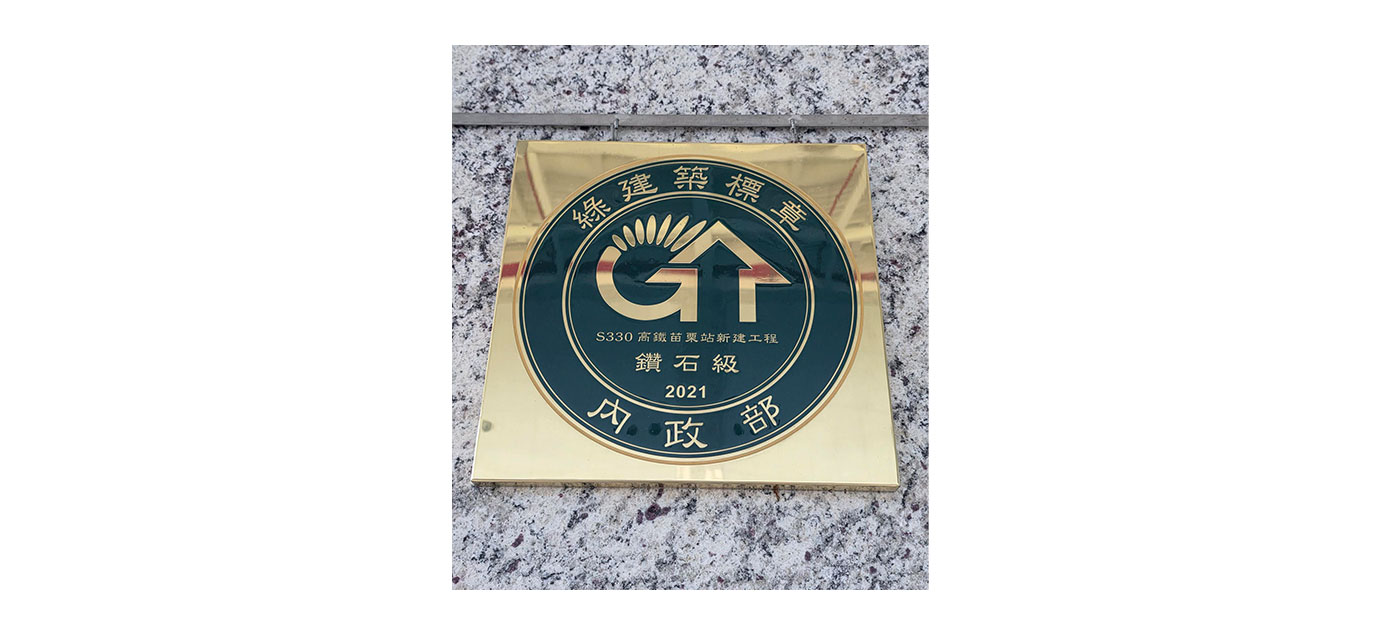
THSRC Miaoli Station Green Building (Diamond Level) Certification Plaque
Stations and Maintenance Depots: Replace Energy-consuming Equipment
All THSRC stations and maintenance depots continue to incorporate a number of energy-saving and equipment-upgrading measures, which include replacing traditional chillers, split-type air-conditioners, hydraulic elevators, and lighting equipment to lower the average electricity consumption per passenger trip in stations (not including public electricity consumption in areas shared with TRC) and maintenance depots.
Trains: Energy Saving Driving Program
The THSRC “Train Energy Conservation Team” has implemented the Energy Saving Driving Program since 2010. The Energy Saving Driving Program advocates appropriate use of train traction and brakes to reduce energy consumption during train operations while maintaining safety, punctuality, and comfort. This program reduces equipment wear and extends equipment life, striking an optimal balance between train operations and energy conservation to maximize energy efficiency. As of year-end 2024, we have reduced electricity consumption by 26,909 MWh and carbon emissions by 13,293 tCO2e。
Advanced Energy Conservation Programs
THSRC has initiated “Advanced Energy Conservation Programs” spanning from 2024 to 2030 to replace energy-consuming equipment and incorporate new energy-saving equipment through several phases, thereby generating energy-saving benefits. The seven programs are:
| Project | Summary | Implementations in 2025 | Project Timeline |
|---|---|---|---|
| Station chiller replacement program | Replace aged chillers with magnetic-bearing variable-frequency centrifugal chillers. | Contracting procedures to replace 9 chillers in 2026 (1 each at Taipei Station, Taoyuan Station, Taoyuan OMC Building, Hsinchu Station, Taichung Station, Chiayi Station, Tainan Station, Wuri Maintenance Depot, and Zuoying Maintenance Depot) were completed in 2025. | Replace 10 chillers in 2026, 8 chillers in 2027, and 10 chillers in 2028. |
| Split-type air-conditioner replacement program | Replace current air-conditioners with variable frequency models that have better energy efficiency. | Replaced 35 air-conditioners at Banqiao Station, Hsinchu Station, Taichung Station, Taibao Maintenance Depot, and Yanchao Main Workshop in 2025. | Replace 40 air-conditioners in 2026, 35 air-conditioners in 2027, and 40 air-conditioners in 2028. |
| Program to replace hydraulic elevators with high-efficiency machine-room-less (MRL) traction elevators | Replace traditional hydraulic elevators with high-efficiency MRL traction elevators. | Began replacing 5 hydraulic elevators (2 at Taoyuan Station, 2 at Taichung Station, and 1 at Zuoying Station) in 2025; construction is scheduled to be completed in 2026. | Replace 3 elevators in 2026, 3 elevators in 2027, 4 elevators in 2028, 5 elevators in 2029, and 5 elevators in 2030. |
| LED energy-saving light replacement program | Replace all energy-consuming lights with energy-efficient LED lights. | Completed 91% of replacements in 2025. | Aim to complete 96% of replacements in 2026 and 100% of replacements by 2027. |
| Air-conditioner EC energy-saving fan integration program | Upgrade air-conditioners and replace old motors with high-performance motors. | Trialed integration of EC energy-saving fans at Zuoying Station in 2025 and currently analyzing energy-saving benefits. | If the trial project achieves expected benefits, the fans will be subsequently be integrated in 62 air-conditioners. |
| Maintenance depot air compressor energy-saving program | Replace old air compressors with new energy-efficient models. | Began replacing two 200hp air compressors with variable frequency 150hp air compressors in 2026; construction is scheduled to be completed in 2026. | All air compressors will subsequently be replaced with variable frequency models. |
| Program to add energy-saving film on glass curtain walls of administration buildings | Upgrade maintenance depot buildings by adding energy-saving film to all glass curtain walls. | Completed additions to the glass curtain walls of Wuri Maintenance Depot in 2025. | Continue to add energy-saving film on the administration buildings of all maintenance depots. |
Renewable Energy Usage
THSRC has installed solar power generation equipment at all maintenance depots and stations in accordance with government energy transition initiatives. We generated 8,964.01 MWh of solar power in 2024. Total power generated at our four maintenance depots amounted to 6,566.75 MWh, which was all sold to Taipower. Our six stations generated 2,397.26 MWh, of which 176.292 MWh was used by the stations, and the remainder was sold to Taipower.
| THSRC Maintenance Depots/Stations | Solar Power Installed Capacity | Electricity Generated in 2024 (MWh) | Total Electricity (MWh) | |
|---|---|---|---|---|
| Maintenance Depots | Wuri Maintenance Depot | 1,436.25 | 1,465.44 | 6,566.75 |
| Yanchao Main Workshop | 3,856.59 | 3,555.10 | ||
| Zuoying Maintenance Depot | 1,410.17 | 983.97 | ||
| Liujia Maintenance Depot | 499.72 | 562.23 | ||
| Stations | Miaoli Station | 72 | 17.63 | 2,397.26 |
| Changhua Station | 99.38 | 60.69 | ||
| Yunlin Station | 93.18 | 97.96 | ||
| Tainan Station | 499.72 | 646.85 | ||
| Chiayi Station | 968.44 | 1,014.01 | ||
| Taoyuan Station | 499.84 | 560.10 | ||
| Total electricity generated in 2024 | 8,964.01 | |||
Regular Review of Energy-Saving Achievements
THSRC has established an Environmental Management Committee which is chaired by the President and composed of the highest-ranking managers of all departments. The Committee supervises THSRC's internal formulations and implementations of environmental policies and goals, convenes quarterly “Environmental Management Meetings” to track progress and achievements on all department environmental projects, and also reviews the energy management promotions and energy savings of all maintenance depots and stations.
Future Prospects
THSRC continues to adopt strategies centered around energy conservation and carbon reduction, energy efficient enhancements, and renewable energy usage in combination with innovative technologies to form systemic and continually improving energy management models. We will continue to uphold our environment responsibilities and social commitments, track progress, improve relevant measures, and work with the government, supply chain, and passengers to promote long-term developments in green transportation as part of our contributions to corporate sustainability, so that THSRC can be an important leader in driving Taiwan towards low-carbon transformations.
Internal Carbon Pricing
THSRC has incorporated internal carbon pricing (ICP) in the corporate carbon reduction governance tools in alignment with one of the Company's six major strategies (“implement carbon reduction actions and fulfill corporate social responsibilities”). We formulated and began implementing ICP mechanisms in 2025, adopting the shadow pricing methodology and referencing the Ministry of Environment Standard Carbon Fee Rate under the Regulations Governing the Collection of Carbon Fees. We set our internal carbon price as NT$300/tCO2e, with implementation scope encompassing Scope 2 greenhouse gas emissions, and regularly review the rationality of our internal carbon prices in consideration of impacts from international and domestic standards, laws, carbon taxes, and carbon prices.
THSRC's ICP mechanisms are applied to all on-site “Advanced Energy Conservation Programs,” which include replacement of energy-consuming chillers, split-type air-conditioners, hydraulic elevators, and lighting equipment (please refer to our Energy Management Plan for further details). Evaluations conducted using our ICP mechanisms estimate that our equipment replacements implemented in 2025 will save 4,193 MWh of electricity, equivalent to 1,987 tons of carbon emissions, which would potentially reduce NT$596,100 in external carbon costs. We aim to continue lowering overall carbon emissions in accordance with our six main strategies.
*Note: Calculations referenced the electricity carbon emission factor (0.474 kgCO2e/kWh) for 2024 announced by the Energy Administration, Ministry of Economic Affairs.